
The documents you should end up with
| Document | Who provides it | What it shows |
|---|---|---|
| Benchmark commissioning checklist | The installing engineer | The boiler was set up and tested to the manufacturer's requirements |
| Building Regulations compliance certificate | Sent via Gas Safe after notification | The installation was notified and meets Building Regulations |
| Manufacturer guarantee registration | Installer or homeowner registers it | The boiler's guarantee is active, subject to terms |
| Installer's invoice and quote | The installer | What was fitted, when and by whom |
The Benchmark checklist
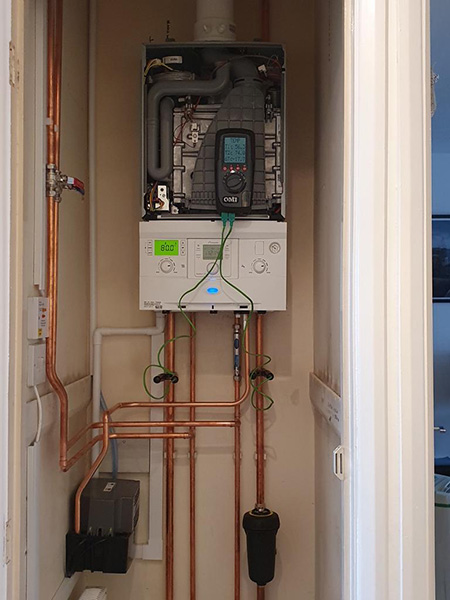
Benchmark is an industry scheme used by boiler manufacturers. At the end of an installation, the engineer completes a commissioning checklist recording things like gas pressure, flue gas readings, controls fitted and how the system water was cleaned and treated. On many boilers this is now completed digitally as well as on paper.
The same record has a service history section. Each annual service should be logged there. Keep it with the boiler manual, because manufacturers and future engineers use it to see how the boiler has been looked after.
Notification and the compliance certificate
Gas Safe registered businesses can self-certify their work. After fitting a boiler, the installer notifies Gas Safe, which passes the information to the local authority building control. A Building Regulations compliance certificate is then posted to the property, usually within a few weeks.
There is a deadline for notification, so if nothing has arrived after a month or so, it is worth asking the installer to confirm they notified the work. Gas Safe can also reissue a certificate if the original has been lost.
If a certificate is missing
- 1
Ask the installer
Start with the business that fitted the boiler. They can confirm the notification date and reference.
- 2
Contact Gas Safe
Gas Safe can check whether an installation was notified at your address and can usually provide a replacement certificate.
- 3
Check the manufacturer
For guarantee registration, the manufacturer can confirm whether the boiler is registered using its serial number.
- 4
Speak to building control
If the work was never notified, the local authority building control can explain the options. The fix normally involves a registered engineer inspecting the installation.
Why buyers and solicitors ask for them
- They show the boiler was fitted by a registered engineer.
- Missing paperwork can slow a sale or lead to requests for an inspection.
- The guarantee and service record can add reassurance about an expensive appliance.
- Landlords also need them alongside annual gas safety records.
Keeping a simple boiler file
A plain folder or envelope near the boiler, or a scanned copy on your phone, saves a lot of searching later. Put in the written quote, the invoice, the Benchmark record, the compliance certificate when it arrives, the guarantee confirmation and each service record. Add the boiler's make, model and serial number on a note at the front.
When you sell, the solicitor can be given copies straight away. When an engineer visits, they can see the history at a glance. And if a guarantee claim is ever needed, the evidence is already together.
If you are buying a home, ask the seller for the same file. Missing certificates on a fairly new boiler are worth raising early, while there is still time to trace the installer.
Other work that is notifiable
Boilers are not the only heating work with paperwork. Installing an unvented hot water cylinder, some electrical work and certain changes to heating systems are also notifiable. If a job involves more than one of these, ask the installer which certificates you should expect and from whom.
Think of the paperwork as part of the boiler. File it together on the day the job finishes and you will never have to chase it in the middle of a house sale.