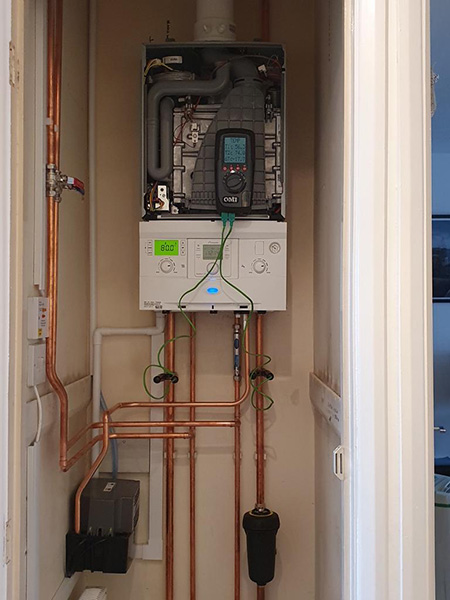
Combi conversions are popular for space rather than efficiency. Out goes the hot water cylinder, out go the loft tanks, and a cupboard and a chunk of roof space come back into use. In a two-bedroom house with one bathroom, it is frequently the best decision available.
In a four-bedroom house with two showers running at breakfast, it is frequently the worst — and no appliance choice rescues it. The difference is entirely about how much hot water leaves the house at once, and how fast the main can replace it.
What the work involves
- 1
Mains flow proven first
Flow rate and working pressure measured at the kitchen tap. If the figures are poor, the conversation should stop before any boiler is chosen.
- 2
Cylinder and tanks removed
Cylinder out of the airing cupboard, cold feed and vent tanks out of the loft, and their supporting boards cleared.
- 3
Redundant pipework dealt with
Old feeds and vents capped back or removed rather than left dead in a ceiling void.
- 4
Hot water reconfigured
Outlets now run at mains pressure, so any shower pump becomes redundant and existing shower valves may need review.
- 5
Boiler positioned and flued
Frequently relocated — a kitchen or utility position is common — with new gas, condensate and flue routes.
- 6
System cleaned and rebalanced
Cleanse, inhibitor, filter, then every radiator brought up and balanced at commissioning.
- 7
Making good
Airing cupboard, loft boarding and any disturbed decoration put back in an agreed state.
What you gain and what you give up
Gains
The reasons people do it.
- Airing cupboard and loft tank space reclaimed
- No cylinder standing heat losses
- Endless hot water rather than a finite tankful
- Mains pressure at showers without a pump
Trade-offs
The realities to accept before committing.
- Simultaneous outlets share one stream and both weaken
- Hot water performance is capped by the incoming main
- No stored water if the mains supply is interrupted
- Immersion heater backup disappears with the cylinder
When keeping stored hot water is the better answer
If two bathrooms are genuinely used at the same time, or the household fills baths while someone showers, a well-specified unvented cylinder with a system boiler will outperform any combi. You keep mains pressure everywhere, lose the loft tanks, and stop hot water performance being hostage to the street's flow rate.
The cupboard stays occupied, which is the honest cost of that decision. For a busy family it is usually a price worth paying — and it removes the daily irritation that no amount of boiler upgrading afterwards can fix.
Conversions are a space decision dressed as a heating decision. Get the mains flow measured, be honest about how many taps run at once, and the right answer usually declares itself within five minutes.