
Every home connected to the mains has a way to cut off the incoming cold water. Inside the property there is normally an internal stopcock, often called a stop tap or stop valve. Outside, usually under a small cover near the boundary, there is an external stop tap that belongs to the water supplier's side of the connection. In a leak, the internal stopcock is the one you want.
The trouble is that most people only look for it when water is already coming through a ceiling. This guide explains where it usually is, how to turn it off and back on, and what to do if it will not move. These are homeowner-safe checks; nothing here involves opening up pipework.
Where the internal stopcock is usually found
It is normally where the mains pipe enters the house, which is often at the front.
- Under the kitchen sink, the most common place in UK houses.
- In a downstairs cloakroom or toilet, near the floor.
- In a utility room, garage or cupboard under the stairs.
- Under floorboards near the front door in some older homes.
- In a flat, possibly in a hallway cupboard, a riser cupboard or a shared service area; ask the managing agent if it is not obvious.
Turning the water off
- 1
Identify the right valve
The stopcock sits on the pipe coming up from the floor. It may have a round tap-style handle, a lever, or a small square spindle.
- 2
Turn it clockwise
For a tap-style handle, turn clockwise until it stops. For a lever valve, turn the lever so it sits across the pipe rather than along it.
- 3
Open a cold tap
Run the kitchen cold tap. The flow should slow and stop after the water already in the pipes drains out.
- 4
Deal with stored water
If you have a cold water tank in the loft, some taps and toilets may keep running from it after the mains is off. That is normal.
What turning off the mains does to your heating and hot water
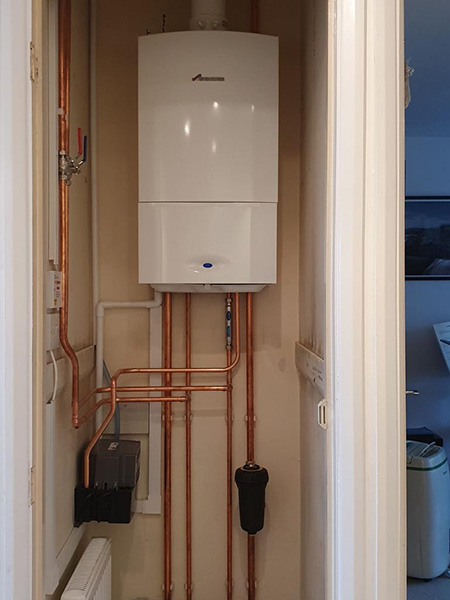
A combi boiler takes its hot water directly from the mains, so with the stopcock closed there will be no hot water at all. The heating side of a sealed system holds its own water and pressure, so radiators can still run; there is no need to switch the boiler off just because the mains is off, unless the leak is near the boiler or its electrics.
Homes with a hot water cylinder still hold a store of hot water. If a leak is coming from the hot side, closing the stopcock may not stop it immediately, and the cylinder may also need isolating. If that is the case and you are unsure which valves to use, call a professional rather than guessing on a pressurised or unvented cylinder.
If the stopcock will not turn
Stopcocks that are left untouched for years can seize. Do not use excessive force or long tools to lever them, because the spindle or the pipe can be damaged, turning a small problem into a bigger one. A stuck valve is a job for a plumber to replace or free while the external supply is isolated.
The external stop tap usually needs a long key that reaches down to the valve under the cover. It may be shared with neighbours, and it is part of the supply network, so contact your water supplier if you need it operated.
A quick preparation checklist
| Check | Why it helps |
|---|---|
| Find the stopcock now | You will not want to search in a hurry |
| Turn it off and on once or twice a year | Keeps it from seizing |
| Label it | Anyone in the house can find it in an emergency |
| Keep access clear | A cluttered under-sink cupboard slows you down |
| Know your boiler type | Tells you what will happen to hot water with the mains off |
Before work starts on your heating
If you are having a new boiler, a cylinder or a heating system installed, your engineer will isolate the water themselves. It still helps to tell them where the stopcock is when they arrive, and to mention if you know it is stiff. Isolating valves on individual taps and appliances are also useful, because they let a single fitting be turned off without cutting water to the whole house.
Planning work on your heating or hot water?
We install boilers, hot water cylinders and central heating systems. Tell us about your home and we will arrange a free in-home survey.
Spend two minutes this week finding your stopcock and checking it turns. It costs nothing, and it is the difference between a damp patch and a ruined ceiling if a pipe ever lets go.