
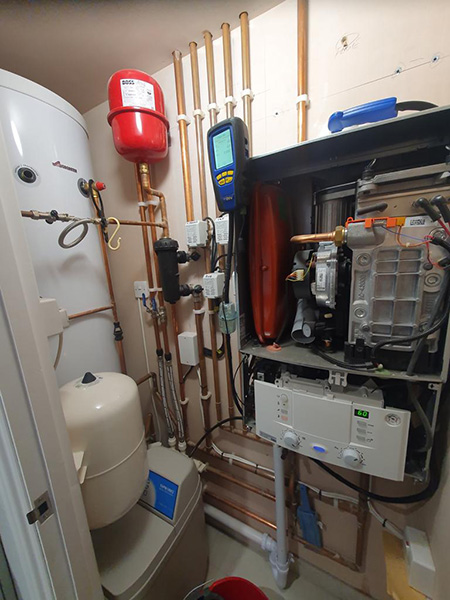
Common plumbing jobs at a glance
| Job | What it usually involves | Can it wait? |
|---|---|---|
| Dripping tap | New washer or cartridge, or a replacement tap if the body is worn | Yes, if it can be isolated |
| Running toilet | Fill valve or flush valve seal replaced inside the cistern | Yes, unless it overflows |
| Leaking pipe joint | Section drained, joint cut out and remade | Depends on the flow rate |
| Burst pipe | Water isolated, damaged length replaced | No |
| Low pressure at one tap | Blocked aerator, part-closed valve or failing cartridge traced | Yes |
| No water anywhere | Stopcock, supply fault or frozen pipe investigated | No |
| Outside tap | Branch taken from the mains with a check valve and isolator | Yes |
| Cylinder or immersion fault | Thermostat, element or valve tested and replaced | Usually a day or two |
Why the cause matters more than the leak
Water rarely escapes where you see it. It runs along pipes and drips from the lowest point, so a stain on a ceiling can be a metre away from the joint that failed. Tracing it properly takes a few minutes longer, but it avoids the familiar pattern of the same leak coming back after a quick fix.
The same logic applies to repeat faults. A toilet that keeps running after a new flush valve may have high incoming pressure; a tap that keeps dripping after new washers may have a scored seat. Asking why the part failed is what separates a repair from a return visit.
Before the plumber arrives
- 1
Find and test the stopcock
Usually under the kitchen sink, in a cloakroom or under the stairs. Turn it clockwise to close. Knowing it works is worth more than any other preparation.
- 2
Clear access
Empty the cupboard under the sink or the airing cupboard and move anything fragile away from the work area.
- 3
Photograph the problem
A picture of a leak while it is happening helps when it only appears at certain times, such as after a shower.
- 4
Note what changed
Recent building work, a cold snap or a new appliance often explains a new fault.
When plumbing becomes an emergency
These need attention the same day because the damage grows by the hour.
- Water coming through a ceiling or light fitting.
- A burst pipe you cannot isolate.
- A tank or cylinder overflowing continuously.
- No water at all in the property.
- A leak near sockets or the consumer unit — switch the electrics off at the board if it is safe to reach.
Go and find your stopcock today, while nothing is wrong. It takes two minutes, and it is the single thing that decides how much damage a leak can do.