
The two things that are actually happening
Almost every overnight pressure drop belongs to one of these.
Water is leaving the system
Somewhere between the boiler and the furthest radiator, heated water is finding its way out. Small losses evaporate before they stain anything, which is why slow leaks go unnoticed for months.
- Radiator valve glands and bleed points, often only when hot
- Compression joints under floors, in airing cupboards and in loft runs
- Corroded radiator seams, usually at the bottom edge
- Towel rail connections in bathrooms where damp is normal anyway
- The pressure relief discharge pipe outside, dripping unseen
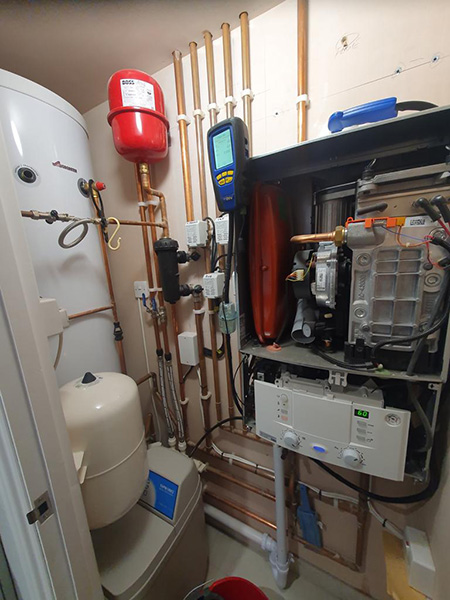
The expansion vessel has lost its charge
The vessel gives heated water somewhere to expand into. When its internal air charge escapes, pressure swings wildly as the system heats and cools, and the gauge appears to lose pressure with no leak anywhere.
- Pressure climbs high when hot, then falls far too low when cold
- The relief valve lifts and dumps water, creating a real loss on top of the fake one
- Recharging or replacing the vessel is the fix, not repeated topping up
Narrowing it down without touching the boiler
Everything here is observation. None of it involves opening a gas appliance.
- 1
Note the cold reading
Read the gauge first thing, before heating comes on, and write it down with the date. A single reading tells you nothing; a week of them tells you the rate.
- 2
Compare hot and cold
Read it again once the system is fully up to temperature. A swing of well over a bar between the two points towards the expansion vessel.
- 3
Walk every radiator
Run a dry tissue around each valve body, bleed screw and the bottom seam. Damp patches, rust streaks or white crusting mark the spot.
- 4
Check the outside pipe
Find the small copper pipe emerging through the wall near the boiler. If it is wet or dripping, the relief valve is passing and the water loss is real.
- 5
Look at the ceilings below pipe runs
Faint circular staining, a slightly sagging patch of paint or a musty smell under a bathroom floor all point to an unseen joint.
- 6
Count your top-ups
Weekly refilling is a leak worth finding. Daily refilling means stop, because you are pushing fresh oxygenated water into the system and accelerating corrosion.
Why repeated topping up makes things worse
Every refill introduces fresh mains water, and fresh water carries dissolved oxygen. Oxygen plus steel radiators produces magnetite — the black sludge that blocks heat exchangers, jams pump impellers and leaves radiators cold at the bottom.
So a leak you keep topping up quietly turns into a second, larger problem. A system that has been refilled weekly for a year has usually taken on enough oxygen to need cleaning as well as repairing.
There is also a safety dimension. If the filling loop is left connected and open, the system stays permanently coupled to the mains supply, which is not how a sealed system is meant to operate.
Readings people ask us about
- What should the gauge read when cold?
- Most manufacturers specify roughly 1 to 1.5 bar with the system cold. The exact figure is printed in the boiler's manual and sometimes marked on the gauge face itself.
- Is a slow drop over months a problem?
- A tiny seasonal drift is common and rarely urgent. A repeatable fall you can measure week to week is a leak, and finding it early is cheaper than replacing a corroded radiator later.
- Why does it only drop when the heating runs?
- Heated pipework expands and moves. Joints that seal when cold can weep when hot, then close up again as everything contracts, which is why the puddle has dried by the time you look.
Treat the gauge as a measuring instrument rather than a nuisance. A week of dated cold readings, one hot reading and a walk round the radiators with a tissue will usually tell an engineer more than an hour of poking about — and it stops the slow leak becoming a sludge problem too.