
The noise is unmistakable once you know it: a rumble, a whistle or a rattling boil that rises as the boiler fires and fades as it shuts down. People describe it as a kettle in the wall, and that description is close to what is physically happening.
Water flowing through a heat exchanger should warm steadily and leave. When flow is restricted or the surfaces are furred, pockets of water reach boiling point against hot metal, flash to steam and collapse again. The banging you hear is those bubbles imploding.
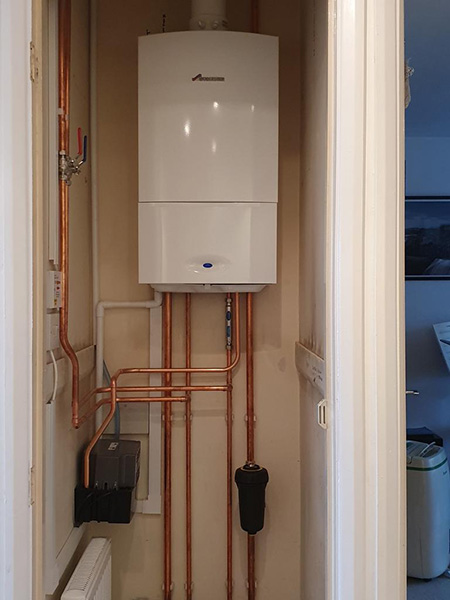
What restricts the flow in the first place
Kettling is nearly always a flow problem or a scale problem, and often both.
- Limescale on the heat exchanger surfaces, common wherever the water supply is hard
- Magnetite sludge from system corrosion narrowing the exchanger passages
- A pump running too slowly, or set to the wrong speed after a repair
- A partly closed isolation valve left behind after earlier work
- A blocked or neglected magnetic filter that has stopped catching and started restricting
- A failing thermistor letting the burner run on when it should modulate down
Why the noise itself is the damage
Steam bubbles forming and collapsing against metal is a violent process at a small scale. It stresses the exchanger, works joints loose over time and puts the appliance through thermal cycling it was never designed for.
There is a second cost. A boiler that keeps overheating locally will cut out on its overheat protection, relight, and cut out again. That short cycling burns more gas for less useful heat, so the running cost rises while the comfort falls.
None of this is improved by turning the thermostat down. It changes how often you hear the noise, not what the noise is doing.
Matching the sound to the likely cause
Not diagnostic on its own, but it helps describe the fault accurately when you call.
| What you hear | When | Usual direction of travel |
|---|---|---|
| Rolling boil or rumble | Shortly after the burner lights | Scale or sludge on the exchanger surfaces |
| High whistle | While hot water is running | Restriction in the plate exchanger of a combi |
| Banging that stops abruptly | Boiler cuts out then relights | Overheat protection tripping on poor flow |
| Noise only on heating, never hot water | Radiator circuit calls for heat | Circulation fault in the heating side or pump speed |
Descriptions are a starting point. Confirming the cause needs gauges, temperatures and the cover off.
What an engineer does about it
- 1
Measure the temperature difference
Flow and return temperatures across the boiler reveal whether water is moving through the exchanger at the rate it should.
- 2
Assess system water quality
A sample tells you whether corrosion has been running unchecked and whether inhibitor is still present at all.
- 3
Check pump and valve settings
Speed setting, any partly closed isolation valve, and whether the filter has been serviced or ignored.
- 4
Clean rather than mask
Depending on findings, a chemical cleanse or power flush removes sludge; scale in a combi's plate exchanger may need descaling or replacement.
- 5
Protect the result
Fresh inhibitor, a working magnetic filter and a scale reducer where the water supply justifies one.
- 6
Judge the appliance honestly
On an old boiler with a scaled exchanger, cleaning may buy time rather than fix it, and replacement becomes the more sensible conversation.
Book a look at a noisy boiler
We measure flow and return temperatures, check the system water and pump behaviour, and tell you plainly whether cleaning solves it or the appliance is near the end.
The useful thing to remember about kettling is that it is a symptom of the water, not a personality trait of the boiler. Deal with what is in the system and the noise goes with it; treat the noise as normal and the appliance eventually makes the decision for you.