
If your boiler was fitted after 2005, it is almost certainly a condensing boiler. Building Regulations made them the standard for new and replacement gas boilers in England and Wales from April 2005, because they turn far more of the gas you pay for into heat for your home.
The idea is simple once you see it. Burning gas produces hot exhaust gases, and a lot of that heat used to disappear straight out of the flue. A condensing boiler squeezes extra heat out of those gases before they leave, and the by-product of doing that is water. This guide explains the process, what it means for your pipework and controls, and how to keep the boiler working at its best.
The condensing process, step by step
Inside the casing, five things happen every time the burner fires.
- 1
Gas burns
The burner mixes gas and air and ignites it. The flame heats the main heat exchanger, which carries the water that goes round your radiators or to your taps.
- 2
Hot gases pass through a larger heat exchanger
Instead of leaving straight away, the exhaust gases are routed through a bigger, more efficient heat exchanger, giving up more of their heat to the returning water.
- 3
Water vapour condenses
When the gases cool below roughly 55°C, the water vapour they contain turns back into liquid. Changing from vapour to liquid releases extra heat, known as latent heat, which the boiler also captures.
- 4
Condensate drains away
The mildly acidic water collects in a trap and runs out through a plastic condensate pipe to a drain.
- 5
Cooler gases leave the flue
What leaves the flue is much cooler than with an old boiler, which is why you often see a white plume of vapour outside on a cold day.
Why the return temperature matters so much
A condensing boiler only condenses when the water coming back to it from the radiators is cool enough to chill the flue gases below their dew point. As a rough guide that means a return temperature below about 55°C. If the system sends water out very hot and it comes back nearly as hot, the boiler still works but behaves more like an old non-condensing model, and much of the efficiency gain is lost.
That is why heating engineers talk about flow temperature, radiator sizing and controls when fitting a new boiler. A boiler set to send water out at 80°C into undersized radiators will rarely condense. The same boiler running at a lower flow temperature, with radiators big enough to heat the rooms and controls that let it modulate down, will condense for most of the heating season.
Modern controls help here. Weather compensation and load compensation lower the flow temperature automatically when less heat is needed, keeping the return cool for longer.
What a condensing boiler needs that older boilers did not
A condensate pipe
The condensate has to go somewhere. It is piped to an internal waste, a soil stack or, where that is not possible, an outside drain or soakaway.
- Internal routes are preferred
- External runs need a larger pipe and insulation
- A frozen external pipe can stop the boiler
A suitable flue position
Because the exhaust is cool and damp, it produces a visible plume. The flue terminal has to meet clearance rules from windows, doors, boundaries and other openings.
- Plume kits can redirect vapour
- Positions are set by regulations and the manufacturer
Clean system water
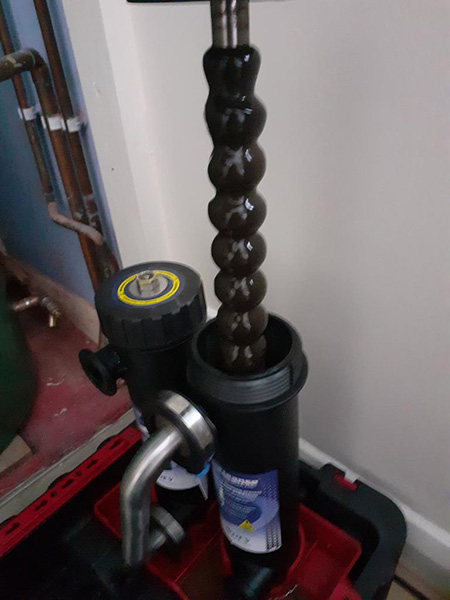
The larger, finer heat exchanger in a condensing boiler is more sensitive to sludge and debris than the chunky cast iron of old boilers.
- Flush before fitting
- Magnetic filter on the return
- Inhibitor in the water
Simple ways to help your boiler keep condensing
None of these involve opening the boiler. Anything inside the casing is a job for a Gas Safe registered engineer.
- Ask your engineer whether the heating flow temperature can be turned down, and test it for a week to see if the house stays comfortable.
- Use the boiler's own controls or a compatible thermostat that can modulate rather than simply switching on and off.
- Keep thermostatic radiator valves working so rooms do not overheat and push hot water back to the boiler.
- Have the boiler serviced every year so the heat exchanger and condensate trap stay clean.
- Check any outside condensate pipe is insulated before winter.
Condensing boilers and older systems
Fitting a condensing boiler to an older system is routine, but it is the moment to fix the things that stop it condensing. Small radiators that were sized for a boiler running at 80°C may need upgrading in the coldest rooms. Open-vented systems with a tank in the loft can stay as they are or be converted to sealed, depending on the boiler type you choose and the condition of the pipework.
Old systems also tend to carry years of sludge. Cleaning the water before the new boiler goes on, then fitting a magnetic filter, protects the heat exchanger and helps the manufacturer's warranty. Your installer should explain which of these steps your system needs and why, rather than treating every house the same.
Replacing an older boiler?
Our Gas Safe registered engineers survey the flue, condensate route and system water before recommending a new boiler. Ask for a free, no-obligation quote.
A condensing boiler is only as efficient as the system you put around it. Cooler return water, sensible controls and clean pipework are what turn the label on the box into lower bills in your home.