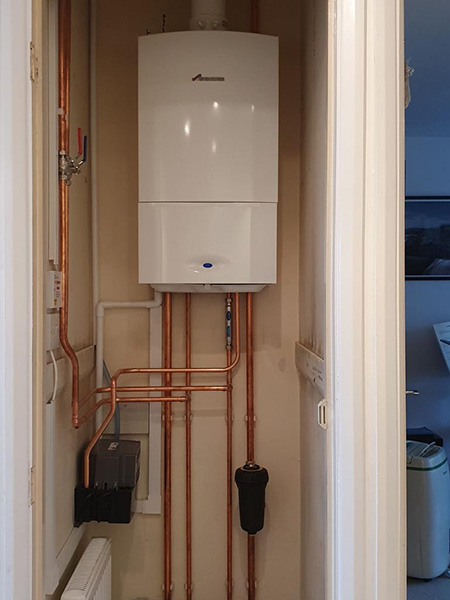
Water expands as it heats. A central heating system must give that extra volume somewhere safe to go, and the two familiar approaches are an open-vented arrangement and a sealed arrangement. The terms describe the heating circuit that warms radiators, not whether the hot water cylinder is vented or unvented.
An open-vented circuit normally has a small feed and expansion tank at a high point. A sealed circuit instead uses an expansion vessel and a pressure gauge, with a controlled means of filling. Both can provide effective heating when designed and maintained correctly, but they behave differently during alterations and when something goes wrong.
How an open-vented circuit accommodates expansion
The feed and expansion tank holds a small reserve of heating-system water and provides a connection to the circuit. As the water warms, expanded volume can move towards the tank. A separate open vent allows air to escape and prevents the circuit becoming pressurised beyond its intended arrangement.
The tank also maintains the system's water level through a float valve. Because it is usually above the rest of the circuit, access for inspection can be awkward and the surrounding space may be cold. Tank, vent and feed positions are functional details, not leftover plumbing that can be capped casually.
Open vented does not mean the radiators are full of air or that water is exposed throughout the system. The main pipework remains a closed circulating loop; the designated tank and vent provide its connection to atmosphere.
How a sealed circuit handles the same water
A sealed heating circuit has no feed and expansion tank connected to atmosphere. It contains an expansion vessel with a flexible diaphragm and a gas charge on one side. As system water expands, the vessel accepts the additional volume while keeping pressure within the intended range.
A gauge displays circuit pressure, and a filling arrangement allows water to be added when required. A pressure relief valve provides a safety path if pressure rises too far. These parts form a coordinated arrangement; repeatedly adding water without finding why it was lost is not normal maintenance.
Pressure changes between cold and hot operation are expected to some extent. A pattern of repeated pressure loss, discharge from the safety pipe or an unusual rise needs diagnosis. The boiler casing, vessel charge, relief valve and gas components are not homeowner repair items.
The two arrangements side by side
| Feature | Open vented | Sealed |
|---|---|---|
| Expansion accommodation | High-level feed and expansion tank with open vent | Expansion vessel within the sealed circuit |
| Water top-up | Float valve in the tank | Controlled filling arrangement |
| Pressure display | Not normally shown on a boiler gauge | Gauge indicates circuit pressure |
| High-level components | Tank and associated pipework required | Feed and expansion tank not required |
| Safety arrangement | Open vent path | Pressure relief and correctly designed expansion |
| Cold-weather exposure | Loft or high-level tank and pipes may be vulnerable | External and unheated pipes still need protection |
Do not confuse heating and hot water terminology
A home can have an open-vented radiator circuit and an unvented domestic hot water cylinder, or a sealed radiator circuit alongside a vented cylinder. The two water circuits are separate. One heats water that circulates through radiators; the other stores water that comes out of taps.
This matters when reading quotes. Removing a feed and expansion tank as part of sealing the radiator circuit does not automatically convert the hot water cylinder to unvented. Conversely, changing a cylinder does not by itself tell you how radiator circuit expansion is managed.
A survey should identify both arrangements explicitly. Unvented hot water work requires G3 competence, while alterations to a gas boiler or its gas supply require a Gas Safe registered engineer.
What conversion or boiler work must consider
- Whether existing pipework, radiators and valves are suitable for sealed operation.
- Correct expansion vessel sizing and location for the system volume.
- Pressure relief discharge, filling arrangements and a readable pressure gauge.
- Removal or proper adaptation of redundant tank and vent connections only as part of the designed work.
- System cleaning, water treatment, ventilation of air and final pressure checks.
- The boiler manufacturer's requirements and safe recommissioning by a Gas Safe registered engineer.
Identify the radiator circuit and the domestic hot water arrangement separately; once those are clear, quotes and proposed changes become much easier to understand.