Your boiler has two temperatures that matter. The room temperature is set on your thermostat. The flow temperature is how hot the water is when it leaves the boiler and heads to your radiators. On many boilers it is set on the front panel with a dial or button marked with a radiator symbol.
Many boilers leave the factory, or were set up years ago, with the heating flow at 70 to 80°C. That heats radiators quickly but often stops a condensing boiler from condensing. This guide explains why, how a lower setting can help and what to watch out for. It covers the settings you can reach on the outside of the boiler only; anything inside the casing is work for a Gas Safe registered engineer.
Flow, return and why the gap matters
Water leaves the boiler at the flow temperature, travels round the radiators giving up heat and comes back cooler. That cooler water is the return. A condensing boiler only recovers the extra heat from its flue gases when the return water is cool, roughly below 55°C.
If the flow is set at 80°C, the return often comes back well above that threshold and the boiler spends much of its time not condensing. Lower the flow and the return drops with it, so the boiler condenses for more of the time and turns more of its gas into heat.
Trying a lower flow temperature
This is a user setting on most boilers. If yours is hidden behind a code or a cover, ask your engineer at the next service.
- 1
Find the heating setting
Check your boiler manual for the central heating temperature control. Do not confuse it with the hot water setting.
- 2
Note the current value
Write it down so you can return to it if needed.
- 3
Turn it down gradually
Many people try somewhere around 60°C as a starting point, then adjust.
- 4
Live with it for a week
Rooms take longer to warm up. Bring the heating on a little earlier rather than turning the flow back up straight away.
- 5
Adjust if rooms fall short
If one or two rooms struggle in cold weather, those radiators may be undersized. Note which rooms they are.
What a lower flow temperature changes
| Effect | What to expect |
|---|---|
| Radiator surface | Warm rather than too hot to touch |
| Warm-up time | Longer, so schedules may need to start earlier |
| Boiler efficiency | More condensing, especially in milder weather |
| Cycling | Often fewer short on-off cycles |
| Coldest days | Some homes need a slightly higher setting in deep winter |
When the radiators cannot keep up
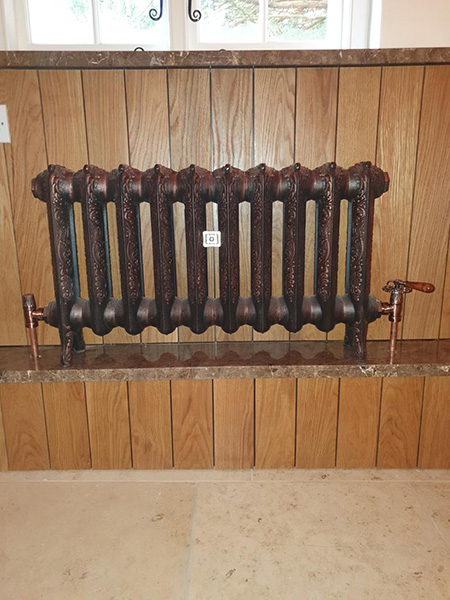
Radiators are rated for a particular temperature difference between the water and the room. Run them cooler and they give out less heat. In a well-insulated home with generously sized radiators, that hardly matters. In a home with small radiators or a draughty room, it can leave that room short on the coldest days.
The fix is not always to turn the flow back up. Replacing one or two undersized radiators with larger ones, balancing the system so heat goes where it is needed, or adding weather compensation so the flow rises only when it is cold outside can give you the efficiency without the cold room. A heat loss calculation shows which rooms need more radiator.
Flow temperature and weather compensation together
A fixed flow temperature is a compromise: high enough for the coldest days, which means too hot for mild ones. Weather compensation removes that compromise by using an outdoor sensor to set the flow temperature automatically, so on a mild October day the boiler might run gently cool, then raise the temperature as a frost sets in.
Load compensation does something similar from the inside, using the room thermostat's reading to modulate the boiler as the room nears its target. Both work best with radiators that are sized correctly, which is why flow temperature, radiator sizing and controls are best looked at together when a new boiler is being planned. A heating engineer can tell you which controls are compatible with your boiler.
Turning the flow down is one of the few heating changes that costs nothing to try. If it shows up a cold room, that tells you exactly which radiator to look at next.